Work

Case studies.

Three tools I built or am building: the problem, what I made, and what it could save.

Projected All outcomes are Projected, based on example assumptions, not measured results.

Case study 1

In use

CFPS Command Center

The problem

I manage the University of Tampa Center for Public Speaking. That means 14 tutors and about 4,000 clients a year. Schedules, hour logs, payroll, and time-off requests lived in separate places. Every week started with cleanup.

What I built

  • A single dashboard I now run the center from.
  • Tutor schedule and weekly hour logs in one view.
  • Payroll tracked live against the semester budget cap.
  • Time-off requests that sync in from a form every hour.
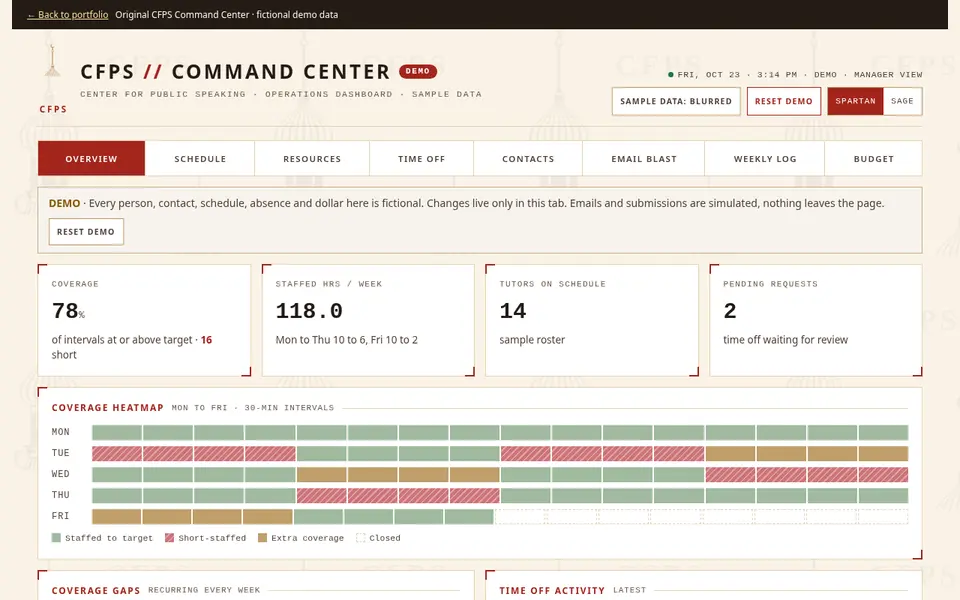
CFPS Command Center demo dashboard with fictional data: tutor schedule, hour logs, payroll vs budget
Demo screen, fictional data.

Try the operations demo

Outcomes

Projected

960 hrs

Projected hours saved per year (400 admin plus 560 tutor hours)

About $17,280

Projected time value per year (at $18/hr)

Key assumptions: 4,000 clients (known) x 6 minutes saved each (example assumption), plus 14 tutors (known) x 1 hour per week x 40 weeks (example assumptions), valued at $18 per hour (example assumption).
Case study 2

Live

AKPsi Points Calendar

The problem

Alpha Kappa Psi members earn points by attending events. Tracking was manual. Members missed events, and points led to disputes.

What I built

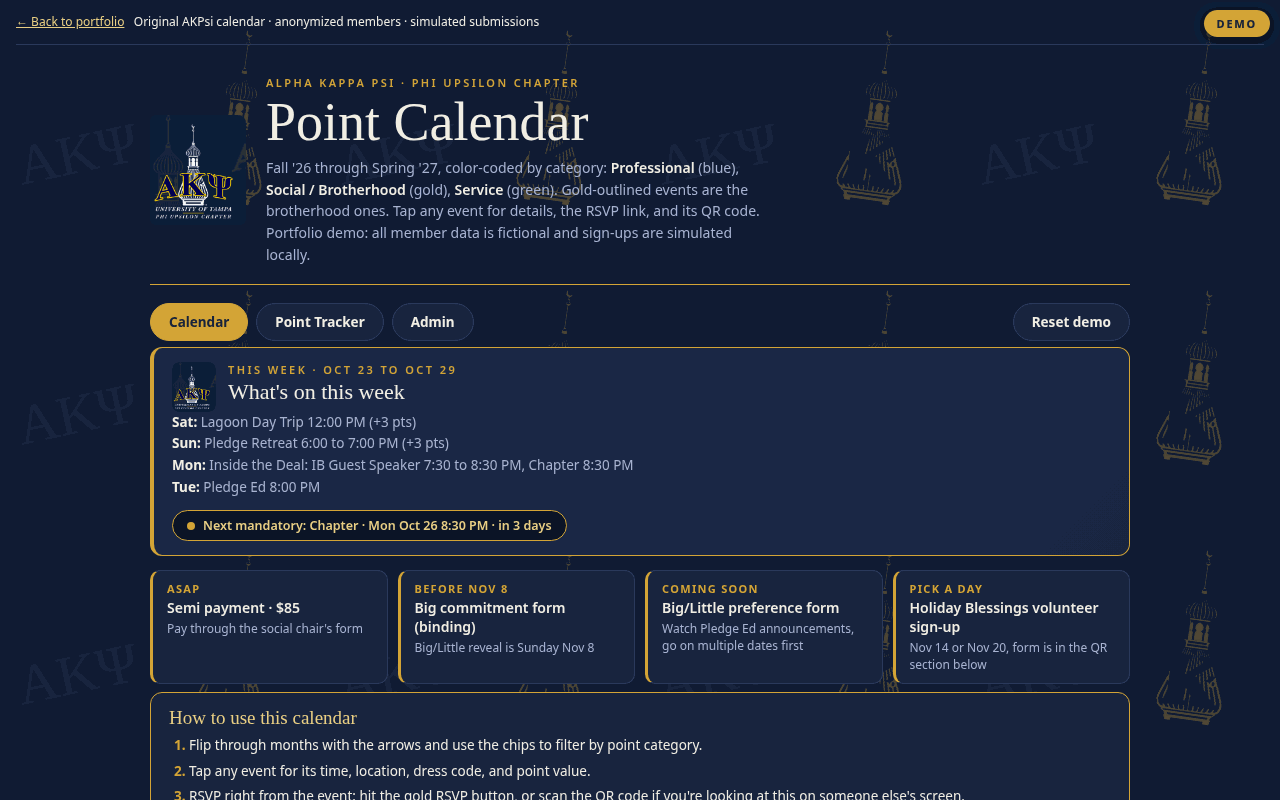
  • A live calendar and points system for the Phi Upsilon chapter.
  • Every event adds itself to members' calendars automatically.
  • QR codes for RSVPs, with events color-coded by point type.
  • A points tracker with a what-if planner.
  • A request form for new events, plus a weekly auto-refresh.
AKPsi Points Calendar demo with fictional data: event calendar color-coded by point type and a points tracker
Demo screen, fictional data.

Try the interactive demo

Outcomes

Projected

75 hrs

Projected chair hours saved per year, about 83% less tracking time

15 of 20

Projected point disputes avoided per semester

Key assumptions: tracking drops from 3.0 to 0.5 hours per week over 30 weeks; 20 disputes per semester with a 75% reduction. All are example assumptions.

Case study 3

In design, not built

CFPS Chatbot (Ask CFPS)

The problem

About 4,000 clients a year ask the same questions. Is the center open? Who is working? How do I book? Each one takes staff time.

What I'm building

  • A chatbot, now in design, as part of a new CFPS website.
  • Knows if the center is open and which tutors are in.
  • A 30-second walkthrough for booking in Navigate.
  • Hours by day, speaking tips, and speech contest details.

Screens coming when the design is final.

Outcomes

Projected

3,200 of 8,000

Projected client questions per year answered by the bot

About 267 hrs

Projected staff hours saved per year (about $4,800)

Key assumptions: 4,000 clients (known) x 2 questions each x 40% answered by the bot, 5 staff minutes per question, $18 per hour. All but client count are example assumptions.

How these were estimated

Inputs behind the projections
InputValueLabel
CFPS tutors14Known fact
CFPS clients per year4,000Known fact (approximate)
Admin minutes saved per client6Example
Tutor coordination hours saved per tutor per week1.0Example
CFPS operating weeks per year40Example
Questions per client per year2Example
Share of questions answered by bot40%Example
Staff minutes per question5Example
Value of staff time$18/hrExample
Points chair hours per week, before / after3.0 / 0.5Example
AKPsi active weeks per year30Example
Point disputes per semester, before20Example
Dispute reduction75%Example

For recruiters

Hiring for Summer 2027?

B.S. in Finance and B.S. in Entrepreneurship at the University of Tampa, recruiting for Summer 2027 in investment banking and wealth management.